Introducing the Zenith EVM Testnet
Zenith Network
Today, we’re opening the Zenith EVM Testnet to the public, allowing anyone to deploy Solidity applications that compose atomically with Canton.
This testnet is the first public instance opening up Canton’s institutional rails to Ethereum developers. For the first time, developers can deploy standard Solidity applications to Zenith using the Ethereum tooling they already know, with each transaction processed through Canton’s consensus, and finalized on Canton, without rewriting code, learning a new programming language, or trusting a third-party bridge.
Dive into our docs to get started.
Why does it matter?
Canton has spent the last decade becoming the infrastructure global finance actually chooses: privacy-preserving, compliance-ready, and already settling trillions in real institutional volume.
Now, with Zenith EVM testnet, Canton has a native entry point for the EVM developer ecosystem where there has been significant progress building on-chain over the past 6 to 8 years. This gap was discussed in detail in Canton’s own Polyglot Whitepaper identified, and Zenith was built to close this gap.
“This is another key step toward enabling Solidity developers to deploy applications that leverage Canton’s interoperable, institutional-grade infrastructure. Combined with broader growth across the network, this will help accelerate Canton’s utility flywheel.” said Shaul Kfir, Co-founder and Head of Strategic Initiatives at Digital Asset.
Teemu Päivinen, Co-founder and Chief Executive Officer at Zenith, said: "Canton proved that institutions want blockchain infrastructure built for regulated markets. This Testnet opens that infrastructure to Ethereum developers. Teams can start building collateral management, lending, tokenized assets, and perpetual futures directly on Zenith, with a direct line into Canton."
Build with standard EVM tooling
Zenith is not an L2 settling only state roots to Canton, nor is it a bridge: it is an EVM extension to Canton’s core protocol, allowing Daml workflows to trigger EVM events directly.
Zenith EVM is a Reth-based execution environment that exposes standard Ethereum JSON-RPC endpoints, so you can expect your existing workflows to work out of the box. In most cases you only need to point your tools at the Zenith EVM testnet RPC endpoint, and your app is ready to deploy.
Developers can:
● Add Zenith EVM Testnet to Metamask and other wallets
● Deploy standard Solidity contracts on Zenith EVM using Foundry, Hardhat etc.
○ Use standard gas estimation, receipts, events, and ABI decoding
● Deploy Daml contracts on the underlying Canton test network
● Test complex workflows settling atomically across Canton and Zenith EVM
Track transactions across Zenith and Canton
The Zenith EVM Explorer gives you the standard views you’d expect for blocks, transactions and contracts. It also adds a Linked Transactions view that connects each EVM transaction to its corresponding Canton update so you can follow a transaction’s full lifecycle across both environments in one place.
EVM execution coordinated and finalized through Canton
Zenith EVM is best understood as an EVM-based subnet or an EVM extension of Canton as block production, canonical chain state, and finality are all mediated through Canton’s consensus, giving EVM transactions deterministic finality in seconds.
In order to facilitate atomic settlement across Canton and Zenith, we’ve built external_call(), a primitive allowing Daml contracts on Canton to invoke Solidity contracts on Zenith from within Daml workflows. In practice, a single transaction can include Canton-native (Daml) legs and EVM legs, and either all succeed or the whole transaction aborts, without the risk of a partially committed state.
We demonstrated cross-VM atomic workflows end-to-end in our Milestone 2 demo flow, composing a CIP-56 asset on Canton and an ERC-20 asset on Zenith through a Canton-native application atomically, between a Canton-only user and an EVM-only user, with neither needing to know anything about the other’s environment.
Read more about Zenith’s architecture in the Concepts and architecture section of our docs.
Testnet status and network details
The Zenith EVM Testnet runs on a full-fledged Canton test environment, including its own synchronizer, and allows anyone to deploy both Daml and Solidity contracts, and test transaction flows.
The testnet also includes our atomic interoperability solution, Gateway, enshrined into Zenith’s core, so you can test token movements and cross-chain workflows across Canton and Zenith.
One note to consider: the testnet hasn’t been optimized for performance yet, and you should expect changes and upgrades as we put the system under real workloads. We’ll progressively increase throughput and reduce block frequency on our path to Mainnet.
The purpose of this release is to validate the developer experience, test EVM compatibility and workflows including cross-environment token movement, harden Canton-mediated block production, and surface issues before production deployment.
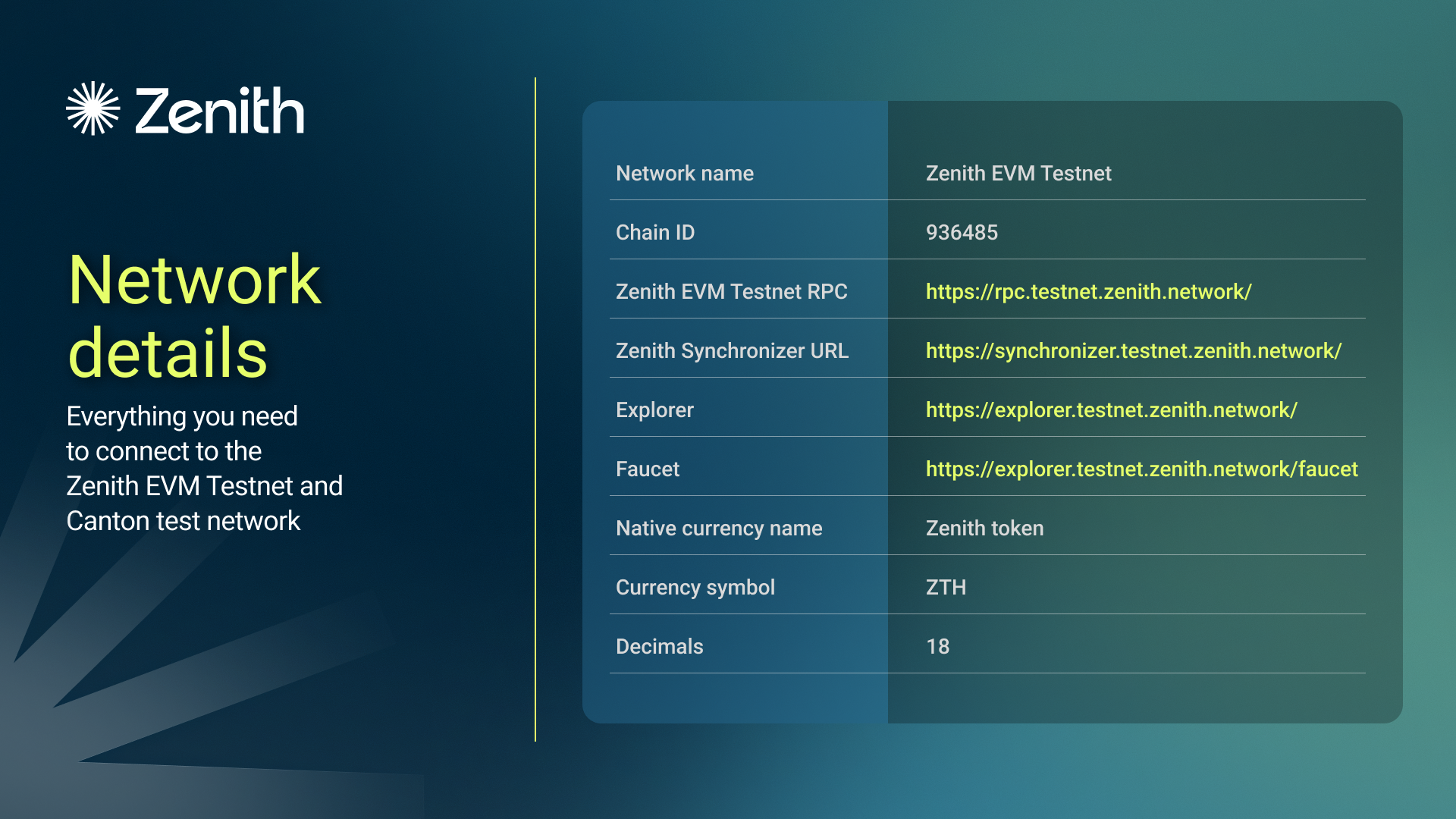
Network details
Network name: Zenith EVM Testnet
Chain ID: 936485
Zenith EVM Testnet RPC: https://rpc.testnet.zenith.network/
Zenith Synchronizer URL: https://synchronizer.testnet.zenith.network/
Explorer: https://explorer.testnet.zenith.network/
Native currency name: Zenith token
Currency symbol: ZTH
Decimals: 18
What comes next?
With the testnet live, our focus shifts to hardening security and optimizing performance as we prepare for production deployments.
The external_call() primitive is scheduled for rollout to Canton MainNet as part of the
upcoming Canton 3.6 release in Q4 2026.
Zenith EVM is aiming to go live on Canton MainNet soon after.
Start building
The Zenith EVM testnet is the first public venue where Ethereum’s programmability and Canton’s institutional rails meet. Start building on the Zenith EVM testnet today:
● Get started: docs.zenith.network
● Explore transactions: explorer.testnet.zenith.network
● Fund a wallet: testnet faucet