Connecting Zenith to external ecosystems: an interoperability pilot with IBC
Zenith Network
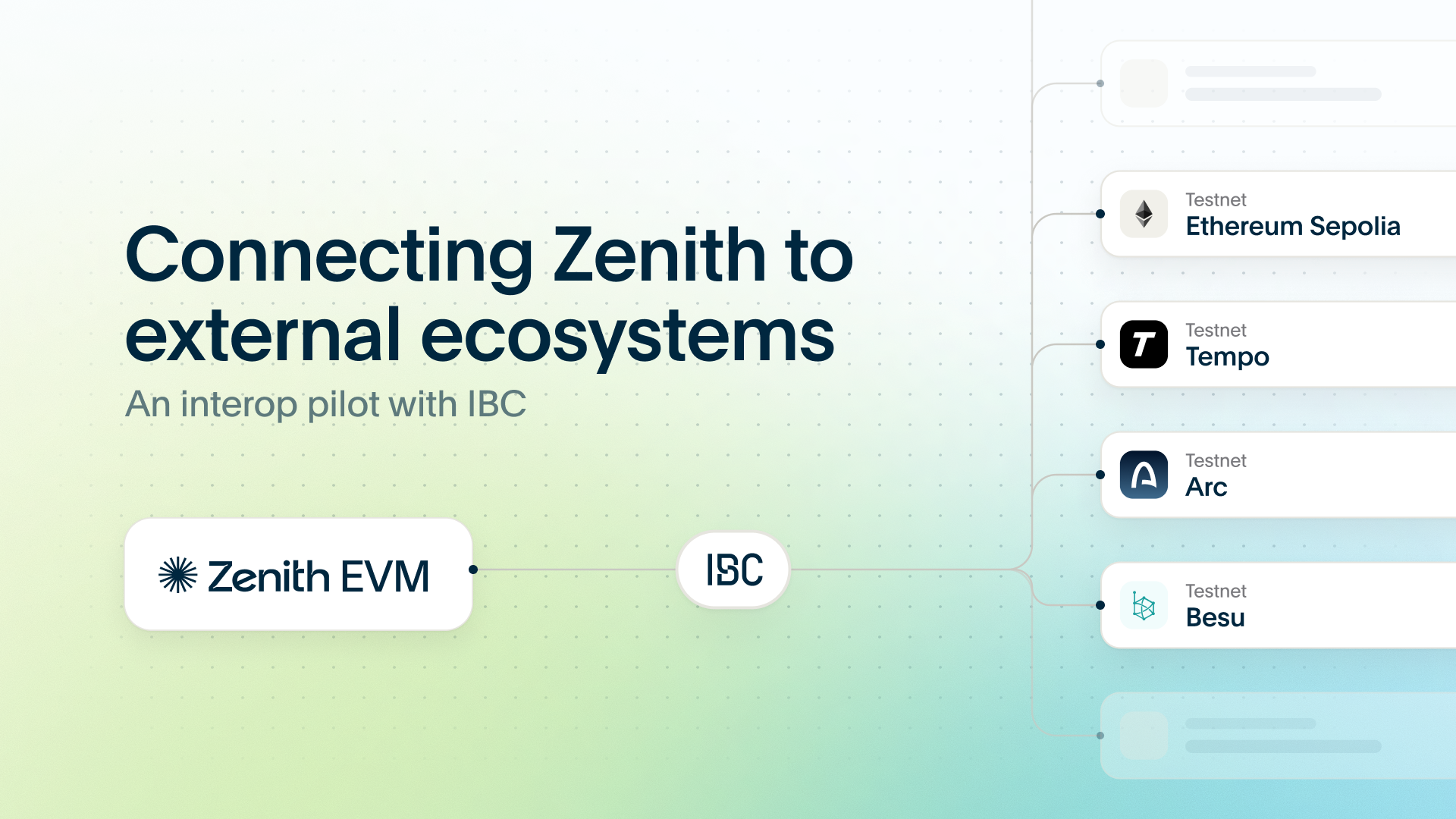
The Zenith EVM testnet already supports atomic asset transfers between Canton and its EVM runtime through Gateway, Zenith’s native interoperability protocol. The next step is connecting Zenith to Ethereum and other blockchain ecosystems.
To explore this, Cosmos, a leading provider of DLT solutions and neutral, open-source digital ledger technology, has built a pilot deployment via the Inter-Blockchain Communication (IBC) protocol linking the Zenith EVM testnet to 15 other testnets, including Ethereum Sepolia, Tempo and Arc testnets, as well as Besu test instances.
In this post, we explain how the integration works, how IBC verifies cross-chain messages, and how the pilot is configured. We then follow a token transfer from Zenith to Ethereum Sepolia and back, with a step-by-step walkthrough and explorer links for every transaction.
Zenith EVM and its public testnet
Zenith is an atomic EVM extension of Canton. It runs a standard, Reth-based EVM, with block production and finality coordinated through Canton’s consensus. It introduces no separate validator set or EVM consensus layer.
Each EVM block is committed within a Canton transaction. Participating Canton validators independently re-execute the block locally, and the Canton mediator finalizes the transaction once the required confirmation threshold is reached. This gives Zenith three key properties:
Deterministic finality: Once the Canton transaction is finalized, the corresponding EVM state is final, with no subsequent EVM reorgs.
A shared trust model: EVM state transitions are validated under Canton’s existing trust model.
Atomic composability: Through the external_call() primitive developed by Zenith, a single Canton transaction can combine Daml and Solidity operations. Either all commit or none do.
The public Zenith EVM testnet runs on a full-fledged Canton test environment with a dedicated synchronizer. Developers can deploy standard Solidity contracts using familiar tools, including MetaMask, Foundry, Hardhat, and Remix. Further architectural details are available in the Zenith testnet documentation.
Zenith EVM testnet - chain ID: 936485
RPC URL: https://rpc.testnet.zenith.network/
Explorer: https://explorer.testnet.zenith.network/
A short introduction to IBC
The IBC protocol is an open-source standard for exchanging messages and assets between independent blockchains. Originally developed within the Cosmos ecosystem, it has operated in production for years, and is now a Linux Foundation Decentralized Trust (LFDT) project. Its implementations support multiple blockchain environments, including EVM networks such as Besu, connecting enterprise deployments to the broader IBC ecosystem.
The Zenith pilot uses the IBC Solidity implementation. This allows the IBC contracts to run directly on compatible EVM networks, with light clients and off-chain infrastructure configured for each connection. Compatibility depends on the deployment’s EVM requirements; the current Solidity contracts require Cancun support.
IBC separates message delivery from verification. Relayers carry messages between chains, while on-chain light clients verify the accompanying evidence. The receiving chain accepts a message according to its configured light client’s rules and trust assumptions.
The main building blocks are:
Light client: An on-chain verifier that checks evidence about another chain. Its verification method determines the connection’s trust model.
Packet: A message containing source and destination client identifiers, a sequence number, a timeout, and application data. In our demo, that data instructs the destination to deliver 5 IBCX tokens to 0x0844…811D.
Packet commitment: A cryptographic commitment stored by IBC Core on the source chain. Supporting evidence allows the destination to verify that the packet was recorded there.
Relayer: An off-chain process that transports packets, verification evidence, and acknowledgements. It submits transactions and pays gas, but message validity is checked on-chain. Relaying is permissionless by default, although deployments can restrict access.
Acknowledgement: The receiving application’s result, relayed back to the source chain. Once verified, it allows the source to clear the packet commitment and process the outcome.
Timeout: A recovery mechanism for packets that were not received before their deadline. Verified evidence of non-receipt allows the source application to process a timeout and, where applicable, refund the sender.
These components form the shared IBC messaging and verification framework.
The application layer defines what those messages do. In our pilot, a general message passing (GMP) application carries a contract call, while an Interchain Fungible Token (IFT) contract handles burning and minting the IBCX test token.

 The IBC pilot on Zenith
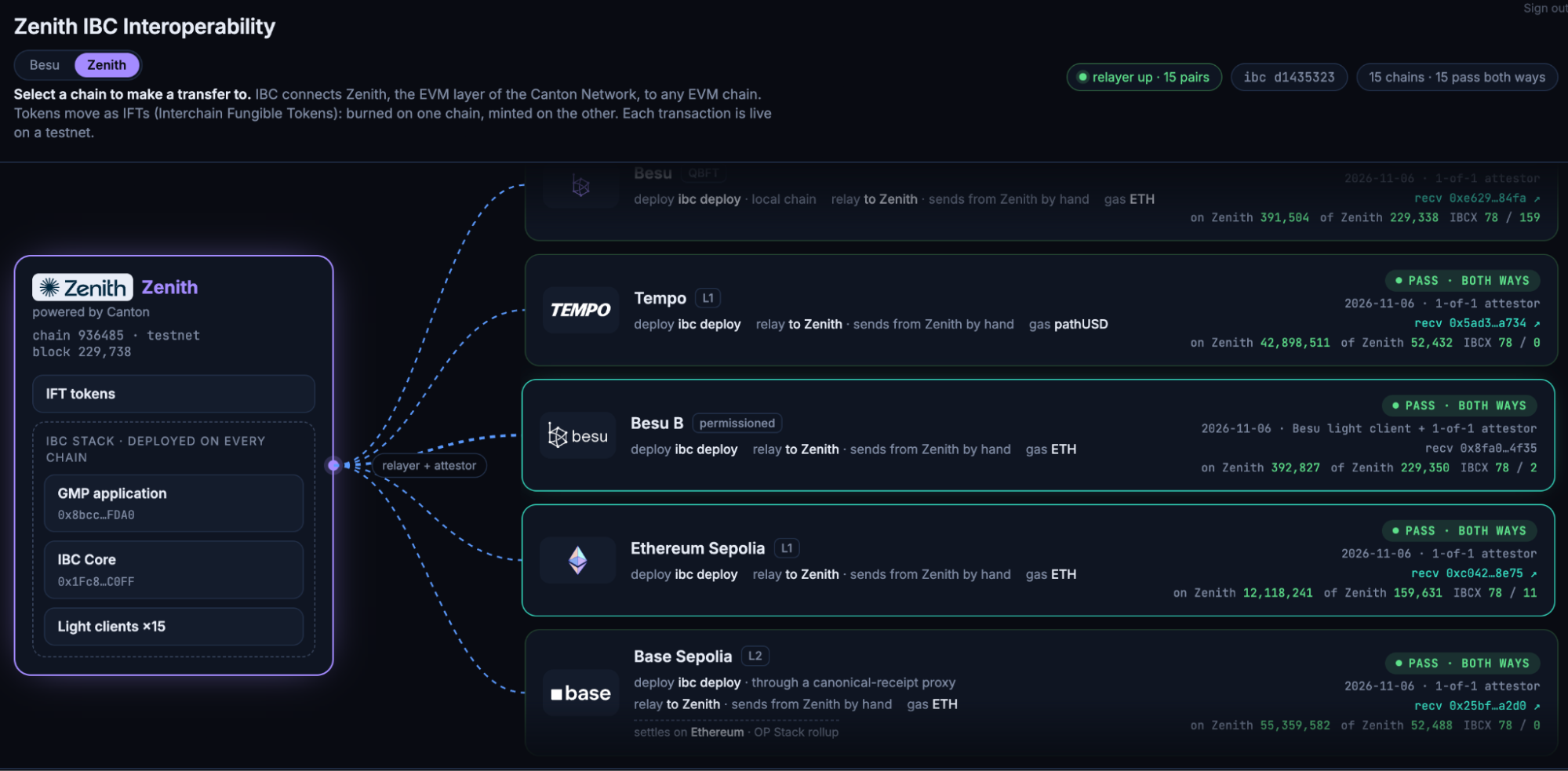
The pilot deploys the IBC stack on Zenith and connects it to 15 external testnets. Each participating chain hosts the contracts needed to send, verify, and execute cross-chain messages.

The pilot demonstrates two verification approaches:
Attestation light clients accept statements signed by a configured threshold of trusted attestors. They provide a flexible way to connect chains, with security depending on the configured signers and their threshold.
Consensus light clients verify the remote chain’s consensus evidence and check state proofs against the verified state. Their trust assumptions are tied to the source chain’s consensus and validator set.
The pilot uses a consensus light client to verify the Besu network’s state and attestation light clients for the other chains.
With that architecture in place, we can follow the full journey of a transfer: burning IBCX token on Zenith, verifying and minting it on Ethereum Sepolia, and subsequently, sending it back.
 Demo (1/2): from Zenith to Ethereum Sepolia
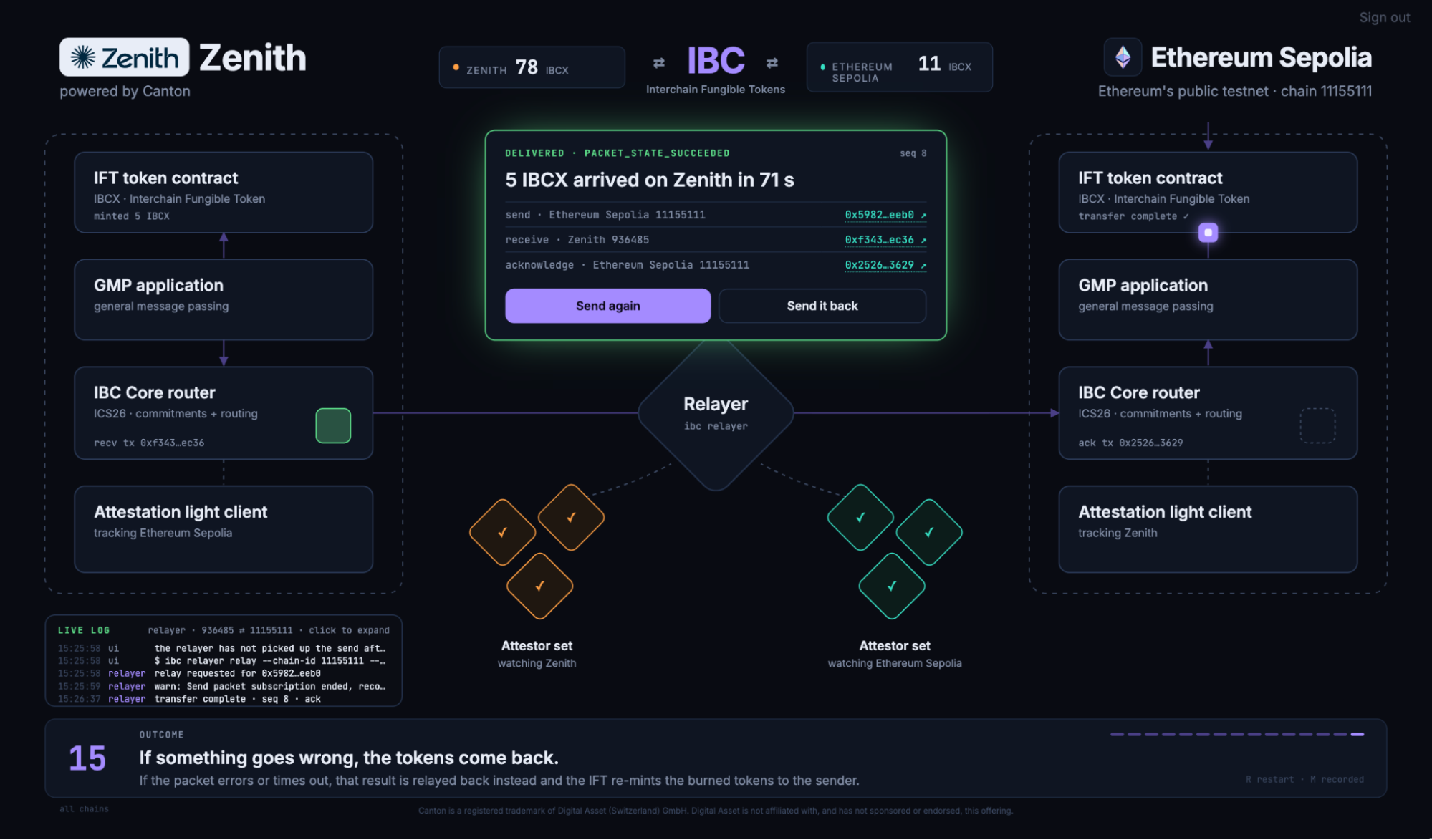
The app's chain page shows the two IBC stacks side by side, with the relayer and the attestor sets between them. We start with the direction from Zenith to Ethereum Sepolia, and initiate a transfer of 5 IBCX tokens.
 Transaction 1: send on Zenith
One Zenith transaction does the first three steps atomically:
Burn: The IFT contract burns 5 IBCX from the sender. The Zenith balance drops to 73 before anything leaves the chain.
Wrap: The GMP application packages the transfer as a payload for Sepolia.
Commit: IBC Core (ICS26) assigns the packet sequence 6 and stores its commitment hash on Zenith. The packet reads: client link-11155111-936485-k2, app GMP → IFT, payload 5 IBCX → 0x0844…811D, timeout send + 15 min.
The Send transaction was final on Zenith within 2 seconds, and because Zenith has deterministic finality, there are no confirmations to wait for.
Link to the transaction on Zenith: 0xadde92de…e76dcd59.
 Transaction 2: receive on Sepolia
Attest: The relayer picks up the packet. The attestor watching Zenith signs that the packet commitment exists.
Deliver: The relayer submits the packet and the signature to IBC Core on Sepolia. In the same transaction, Sepolia's light client of Zenith is updated, and Core verifies the packet against the attestor signature.
Route: Core passes the verified payload to the GMP application on Sepolia.
Mint: The IFT contract on Sepolia mints exactly 5 IBCX to 0x0844…811D. The Sepolia balance rises from 11 to 16.
Link to the transaction on Ethereum Sepolia: 0x1d0883c8…4ff08afd.
 Transaction 3: acknowledgment on Zenith
Result: GMP on Sepolia returns success for the sequence.
Record: IBC Core on Sepolia commits the acknowledgment.
Attest: The attestor watching Sepolia signs that the ack was written.
Carry: The relayer picks up the ack and its proof.
Submit: The relayer submits the ack to IBC Core on Zenith, and Zenith's light client of Sepolia is updated in the same transaction.
Verify and clean up: Core verifies the ack against the attestor signature and deletes the packet commitment. The packet can no longer be replayed or refunded.
Complete: The IFT contract on Zenith learns the transfer succeeded, so the burn is final.
Link to the ack transaction on Zenith: 0xc1bf016a…386156d983.

If anything had gone wrong (an error on Sepolia, or no delivery within the timeout), the error ack or a timeout proof would be relayed back instead. The IFT contract on Zenith would then mint the 5 IBCX back to the sender.
Demo (2/2): sending it back to Zenith
The return leg runs the same 14 steps as the forward leg, with the two chains swapping roles:
Send on Sepolia (0x5982…eeb0): The IFT contract burns 5 IBCX (16 → 11), GMP wraps the transfer, and IBC Core on Sepolia commits sequence 8.
Receive on Zenith (0xf343…ec36): The attestor watching Sepolia signs the commitment. The relayer delivers the packet to IBC Core on Zenith, which updates its light client of Sepolia and verifies the signature. The IFT contract mints 5 IBCX (73 → 78).
Acknowledgment on Sepolia (0x2526…3629): GMP on Zenith returns success, and the attestor watching Zenith signs the ack. The relayer submits it to IBC Core on Sepolia, which verifies it and deletes the packet commitment.
Two things differ from the forward leg. The Sepolia send took about 10 seconds to land, versus about 2 seconds on Zenith. And each direction keeps its own sequence counter, so the return packet is sequence 8 while the forward one was sequence 10.
Result card for the return leg showed: DELIVERED · PACKET_STATE_SUCCEEDED · seq 8, "5 IBCX arrived on Zenith in 71 s".
 Log of all transactions
All six transactions from the round-trip IBC transfer can be independently verified using the links below.
1. Zenith → Ethereum Sepolia (Sequence 10)
Send + Burn: Zenith EVM Testnet (Chain ID: 936485) View transaction: 0xadde…cd59
Receive + Mint: Ethereum Sepolia (Chain ID: 11155111) View transaction: 0x1d08…8afd
Acknowledge: Zenith EVM Testnet (Chain ID: 936485) View transaction: 0xc1bf…d983
2. Ethereum Sepolia → Zenith (Sequence 8)
Send + Burn: Ethereum Sepolia (Chain ID: 11155111) View transaction: 0x5982…eeb0
Receive + Mint: Zenith EVM Testnet (Chain ID: 936485) View transaction: 0xf343…ec36
Acknowledge: Ethereum Sepolia (Chain ID: 11155111) View transaction: 0x2526…3629
Closing thoughts
The IBC pilot sits alongside Gateway, Zenith's native interop solution to Canton.
Together they facilitate that:
Canton-native assets reach Zenith EVM atomically, and from there move over IBC to Ethereum and beyond, and
Assets from other ecosystems reach Zenith EVM through IBC, and become atomically composable with Canton-native apps and applications, once they are on Zenith.
This pilot is an early step and shows what connecting Zenith to other ecosystems through an open, neutral standard looks like in practice. Production-grade integrations will follow as Zenith gets closer to mainnet.
Thanks to the Cosmos team for deploying IBC and building the pilot flow. Over the past five years, IBC has moved more than $50B across 200+ independent networks. Now under LFDT, the home of open-source blockchain technology used by the world’s largest banks and financial institutions, IBC advances Zenith’s mission to build connected global capital markets.
For more details and documentation, visit:
Zenith: docs.zenith.network
IBC: ibcprotocol.dev/docs