From Usage to Revenue. Building on Canton with Zenith EVM
Zenith Network
A harsh fact has been known throughout the history of blockchain and that is that most on-chain applications do not generate sustainable revenue. In fact, 80% of decentralized applications have fewer than 1000 users.
On public blockchains, the relationship between usage and revenue is broken by design. Users generate activity, fees are paid, and the majority of that value accrues to validators or sequencers. The application sitting on top sees almost none of it. Even as usage grows, builders survive on token emissions, liquidity mining, or off-chain monetization strategies that have nothing to do with the network they're building on.
Revenue is not structurally tied to the activity they create. As a result, a gap emerges between adoption and revenue, they have become two separate problems and most teams are left solving both at once with limited resources and a ticking emissions clock.
Canton Network takes a different approach by embedding application incentives directly into the economic flow of the network.
Canton App rewards
Applications on Canton can earn continuous, transaction-based revenue, directly tied to real activity.
As of January 2026, 62% of all Canton Coin ($CC) rewards (~516 million $CC per month) are allocated to featured applications. In essence, user-paid traffic fees are burned, and a portion of the minted $CC flows back to the builders who generate genuine use activity.
Assuming network activity on Canton allows the distribution of the entire reward pool, if your application accounts for 0.25% of total monthly transactions and fee burn, you could become eligible for roughly 1.29 million $CC per month from the app rewards pool. At a $CC price of ~$0.15, that equates to approximately $193,500 USD/month in potential rewards, before any additional app-level fees.
Compare this to typical public blockchains: most dApp revenue comes from their token’s emissions, liquidity mining, or off-chain business models.
This shift to usage-driven economics changes how builders think about growth. Success is no longer measured only by DAUs, TVL, or hype cycles, but by concrete economic contribution: how much real financial activity an application brings, how much in fee burn it contributes to the network, and what share of the recurring reward pool it captures.
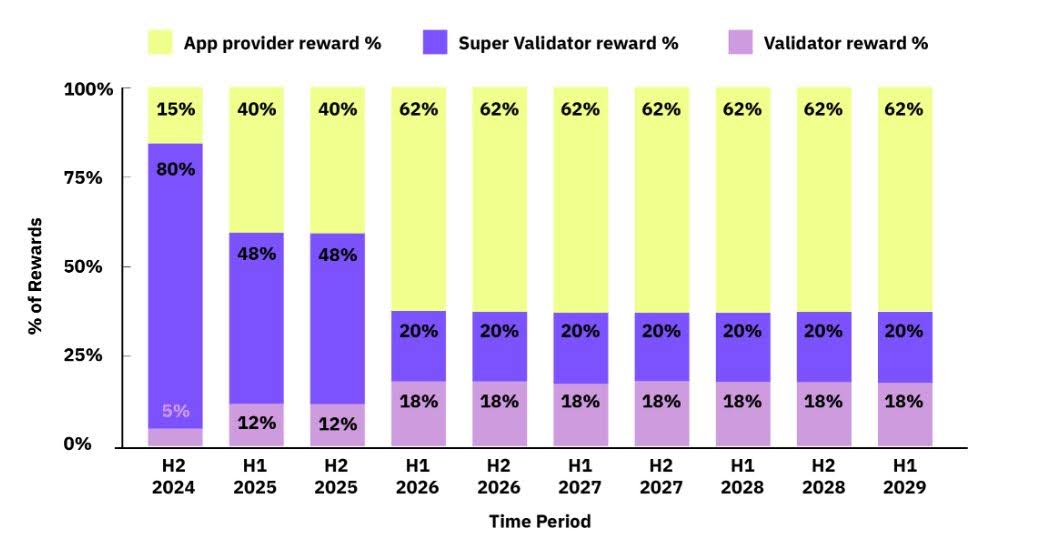
Source: https://www.canton.network/blog/cantonomics-for-app-builders
Extending the model with Zenith
Zenith brings this model to a much broader developer audience. By introducing an EVM-compatible (and soon SVM) execution environment on Canton, Zenith allows developers to deploy Solidity applications that are atomically composable with Canton’s institutional infrastructure, using standard Ethereum tooling.
But how this execution is integrated into the network matters just as much as the execution itself. Zenith’s architecture is different from that of L2s: it does not extract value from Canton like in most L2 architectures that often fragment liquidity and divert transaction volume and fee flows away from the base layer. According to data from L2Beat, in the Ethereum ecosystem today, over 135 L2s and appchains are live, with over 80% of these tracked projects recording negligible traffic, handling <1 user operation per second.
Yet the emergence of so many L2s comes at a cost: liquidity is split across dozens of isolated environments, cross-chain bridging remains slow and risky, and the majority of execution-layer revenue is captured by individual L2 sequencers rather than flowing back to the base layer. In 2025, for example, major L2s generated over $129 million in total revenue, but paid only about $10 million back to Ethereum mainnet in data availability fees, as highlighted in a Phemex analysis of Ethereum’s evolving fee dynamics.
Zenith takes the opposite approach. It reinforces Canton’s unified economic model instead of fragmenting it:
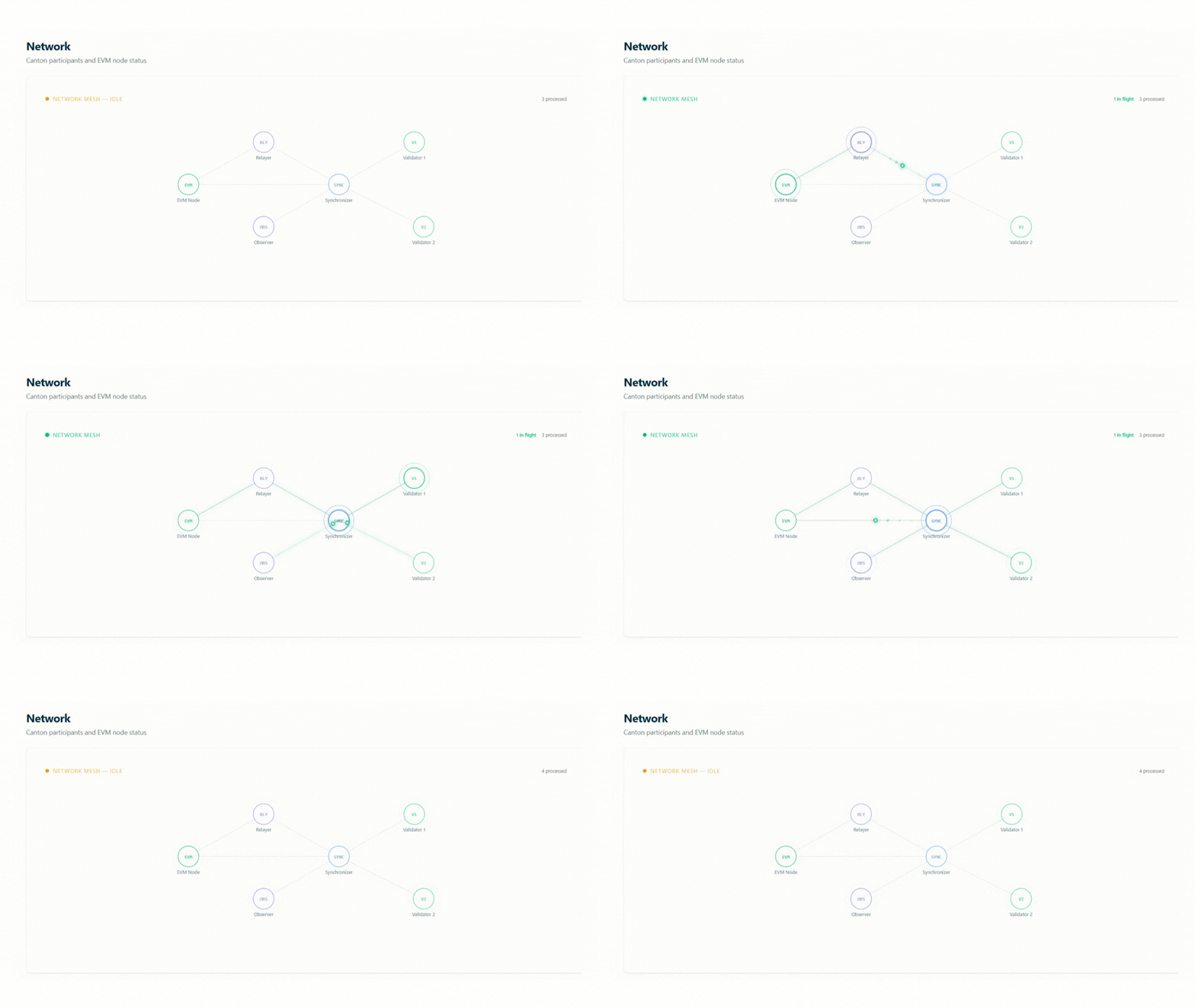
All EVM transactions are routed through Canton and generate CC burn,
Transaction volume remains in Canton,
Fee flows continue to accrue on Canton Network.
With Zenith, execution expands without fragmenting the underlying economic base.
0 emissions games. 100% usage-driven rewards
The blockchain space has been exceptionally good at launching applications and remarkably bad at sustaining them once the initial incentives run out.
We flip this around: applications deployed on Zenith can benefit from Canton’s transaction-based $CC App Rewards model. As applications generate activity through user interactions, financial operations, or asset flows, they become part of a system where value is distributed based on real usage with incentives tied directly to the activity they bring to the network.
This creates a Darwinian but fair filter: the same 80% of low-usage applications receive minimal rewards, while applications that deliver sustained, meaningful volume can capture a significant share of the ~516 million $CC allocated monthly to featured apps. And even though transactions triggering an event in Zenith’s EVM environments incur a fee element denominated in $ZTH which covers the cost of EVM execution, this is analogous to infrastructure costs. All user activity in Zenith EVM continues to accrue fees and burn value in Canton’s token economy.
As a result, as Zenith applications scale in usage, they contribute directly to Canton’s overall economic activity, rather than diverting value away from it.
General purpose blockchains are dead. The true future of blockchain is centered around purpose-built solutions, not empty promises. Canton is ultimately defining the gold-standard for what will be the evolution of modern financial infrastructure. And now with EVM/SVM atomic composability, we're bringing Canton to its Zenith.
Zth.
- Heslin Kim, Co-founder & CBO at Zenith
Access to real financial activity
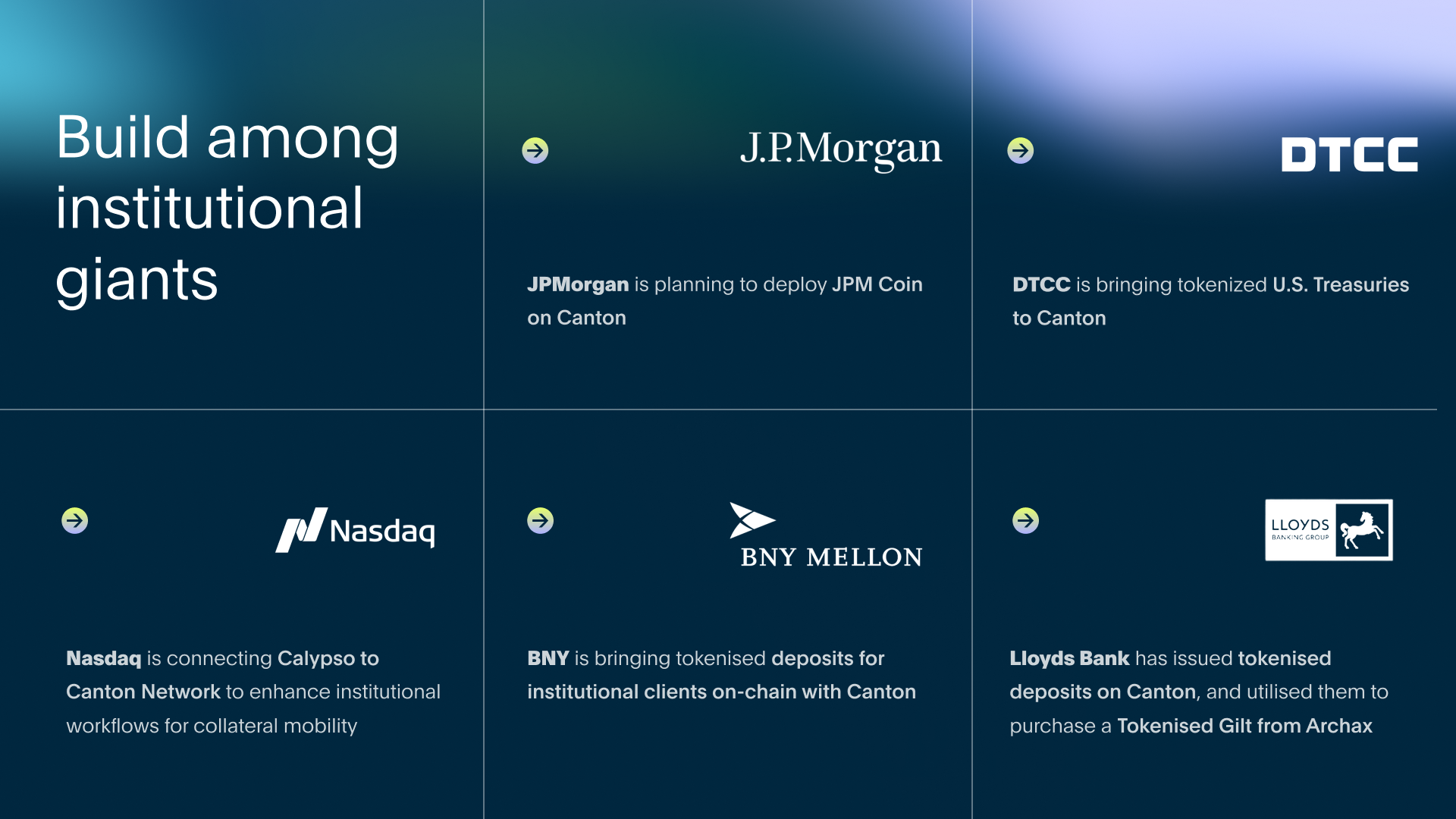
The nature of the native activity on Canton is fundamentally different from most blockchain environments. Canton is already used by major financial institutions including Goldman Sachs, BNP Paribas, JPMorgan, DTCC, Broadridge, Nasdaq, HSBC, Deutsche Börse, and Franklin Templeton, supporting large-scale production operations. The network handles over $6 trillion in tokenized real-world assets across more than 600 institutions and processes up to $350 billion daily in tokenized U.S. Treasury repo activity.
Applications deployed via Zenith are not isolated: they operate in an environment where real financial activity takes place - the same ecosystem where Visa, a Super Validator alongside DTCC, Nasdaq, Broadridge, and other Tier-1 players - giving Web3 innovation access to transaction flows that extend beyond purely speculative use cases.
For builders, this changes the revenue model entirely. A DeFi protocol such as Uniswap or Aave deployed on Zenith can now atomically compose with live tokenized Treasuries or tokenized deposits to offer yield-bearing collateral or private settlement rails for institutions, turning retail innovation into a bridge to TradFi-scale liquidity. Growth is no longer tied only to attracting users within a single ecosystem, but to participating in broader financial activity that is already occurring on the network.
Why this matters
If Ethereum’s developer base can build directly against institutional assets, the result is a structural shift in where financial innovation happens, and is already happening. There are over 100 apps already live on Canton benefitting from $CC App rewards. These applications are not competing for the same pool of speculative activity. They are interacting with systems that move capital at scale. Private and compliant settlement rails that let banks and funds move cash on-chain with full privacy and regulatory coverage. Tokenized money market funds (like Hashnote’s USYC) are actively used as yield-bearing collateral in live repo transactions, allowing institutions to deploy capital dynamically rather than holding idle cash.
Canton introduces a model where value is directly linked to usage. Zenith makes that model accessible to a global developer ecosystem.